Posted on 3rd Nov 2026
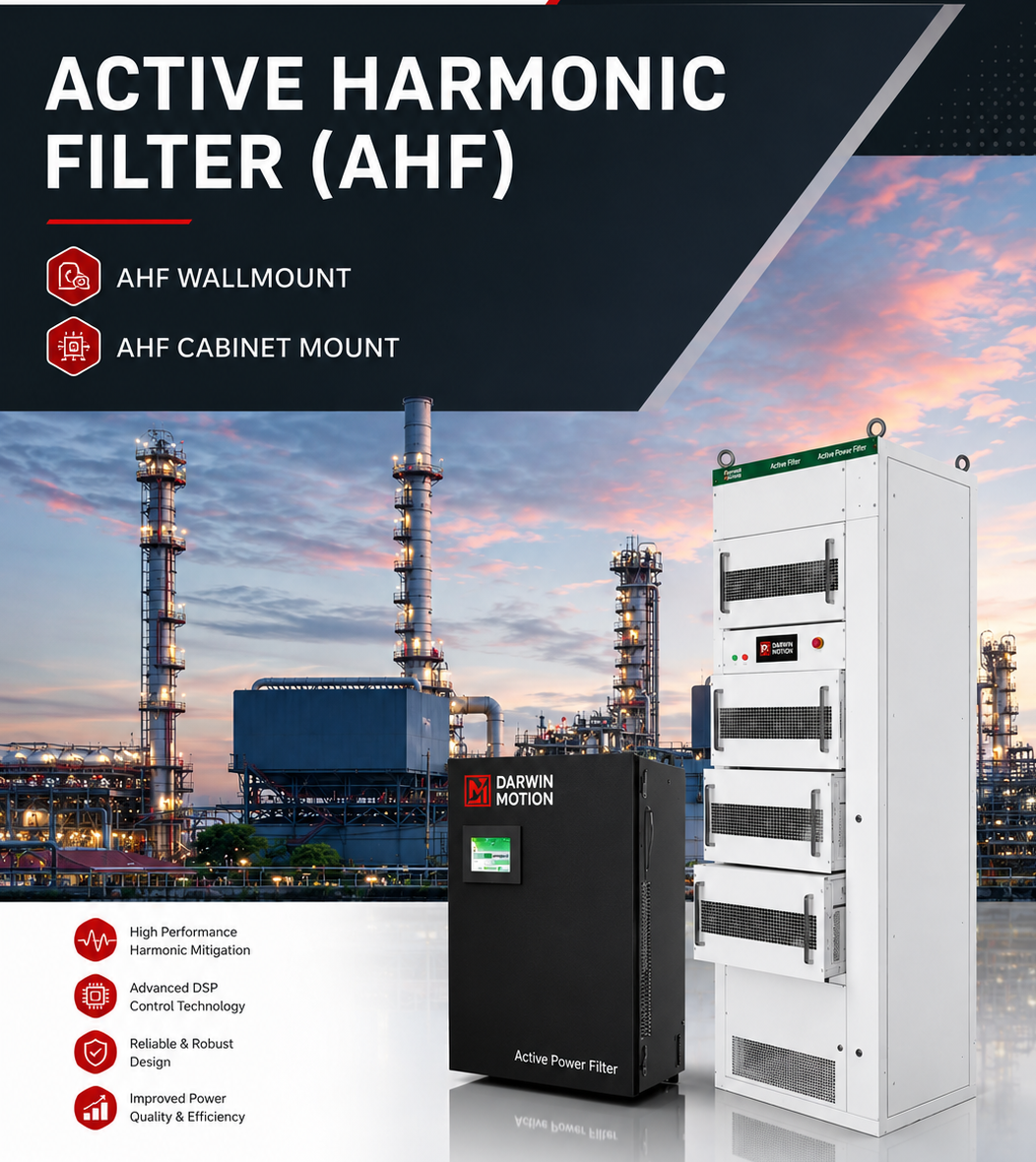
In today's modern industrial environment, maintaining electrical power quality is essential for improving operational efficiency, protecting electrical equipment, and reducing energy losses. Industries use advanced equipment such as Variable Frequency Drives (VFDs), AC Drives, UPS systems, servo drives, and automation systems. Although these technologies improve productivity and process control, they can also generate harmonic distortion in electrical networks.
Harmonic distortion can cause overheating, increased electrical losses, poor power factor, equipment malfunction, and reduced electrical system reliability. An Active Harmonic Filter is an advanced power quality solution designed to minimize these problems by continuously monitoring and compensating unwanted harmonic currents.
As an established Darwin Motion AC Drive Manufacturer, Darwin Motion focuses on industrial automation, AC drives, VFD technology, and advanced power quality solutions. Its Active Harmonic Filter technology helps industries improve electrical performance, reduce harmonic distortion, and maintain reliable operations.
An Active Harmonic Filter (AHF) is an electronic power quality device that detects unwanted harmonic currents in an electrical system and generates compensating currents to reduce their impact.
Harmonics are electrical disturbances caused by nonlinear loads. These loads draw current in a distorted waveform rather than a smooth sinusoidal waveform. Common examples include VFDs, UPS systems, rectifiers, welding machines, battery chargers, and industrial automation equipment.
An Active Harmonic Filter continuously analyzes the electrical current and injects equal and opposite harmonic currents into the system. This compensation helps reduce harmonic distortion and improves the overall quality of electrical power.
Harmonic distortion occurs when electrical current or voltage contains frequency components that are multiples of the fundamental supply frequency.
For example, in a 50 Hz electrical system, harmonic frequencies may include:
Excessive harmonic distortion can affect transformers, motors, cables, capacitors, and other electrical equipment.
The working principle of an Active Harmonic Filter is based on real-time harmonic detection and current compensation. It uses advanced power electronics, current sensors, digital controllers, and semiconductor switching devices to identify and reduce unwanted harmonics.
The filter continuously monitors the electrical current using current transformers or suitable current sensors. It measures the load current and identifies harmonic components present in the electrical network.
The internal digital controller analyzes the measured current waveform and identifies the harmonic frequencies that need compensation. Advanced control algorithms calculate the required compensating current.
The power electronic converter generates a compensating current with a waveform opposite to the detected harmonic components. This current is injected into the electrical system to counteract unwanted harmonics.
The compensating current interacts with the harmonic current generated by nonlinear loads. As a result, the harmonic distortion is reduced and the overall current waveform becomes closer to a sinusoidal waveform.
The Active Harmonic Filter continuously monitors changing electrical loads and adjusts its compensation accordingly. This makes it suitable for industrial facilities where electrical demand changes frequently.
An Active Harmonic Filter consists of several important components that work together to provide effective harmonic compensation.
Installing an Active Harmonic Filter offers several advantages for industrial plants, commercial buildings, and facilities operating nonlinear electrical loads.
One of the primary benefits of an Active Harmonic Filter is its ability to reduce Total Harmonic Distortion (THD). Lower harmonic distortion helps improve electrical power quality and supports reliable operation of industrial equipment.
Excessive harmonics can cause overheating in transformers, motors, cables, and electrical components. By reducing harmonic currents, an Active Harmonic Filter can help minimize unnecessary electrical stress and support longer equipment service life.
Modern Active Harmonic Filters can provide reactive power compensation in addition to harmonic mitigation. Depending on the system configuration and selected operating mode, this can improve power factor and reduce reactive power demand.
Harmonic currents increase additional heating and electrical losses in distribution equipment. Reducing these currents can help improve electrical system efficiency and reduce avoidable energy losses.
Industrial facilities frequently operate multiple Variable Frequency Drives. An Active Harmonic Filter helps manage harmonic currents generated by these nonlinear loads and supports improved power quality across the electrical distribution network.
By minimizing harmonic-related disturbances, Active Harmonic Filters can help reduce equipment overheating, nuisance tripping, and power quality-related operational problems.
Unlike conventional passive filters designed for specific harmonic frequencies, Active Harmonic Filters can dynamically respond to changing load conditions and compensate for multiple harmonic components within their rated capacity.
Active Harmonic Filters are widely used in industries where nonlinear electrical loads create harmonic distortion and affect power quality.
Manufacturing plants use multiple AC drives, motors, automation systems, and industrial machinery. Active Harmonic Filters help reduce harmonic distortion and support reliable electrical distribution.
Textile manufacturing facilities operate spinning machines, winding machines, weaving machines, and other equipment controlled by VFDs. Harmonic filtering helps improve power quality and supports stable machine operation.
Steel plants and metal processing facilities operate heavy electrical machinery, motor drives, welding equipment, and other nonlinear loads. Active Harmonic Filters help reduce harmonic disturbances and protect electrical infrastructure.
Data centers use UPS systems, server power supplies, cooling equipment, and backup power systems. Harmonic mitigation helps maintain power quality and supports reliable operation of sensitive electrical equipment.
Large commercial buildings use HVAC systems, elevators, lighting systems, pumps, and other electrical equipment. Active Harmonic Filters help control harmonic distortion and improve electrical distribution performance.
Water treatment facilities use pumps, blowers, motors, and VFD-controlled systems. Harmonic filtering supports efficient electrical operation and reliable pumping processes.
Pharmaceutical manufacturing facilities depend on precision machinery, automation systems, HVAC equipment, and sensitive electrical controls. Improved power quality helps support stable industrial operations.
Food processing plants use conveyors, mixers, compressors, pumps, packaging machines, and automated production systems. Active Harmonic Filters help reduce harmonic distortion generated by these electrical loads.
Both active and passive harmonic filters are used to improve electrical power quality. However, their operating principles and applications are different.
| Comparison Parameter | Active Harmonic Filter | Passive Harmonic Filter |
|---|---|---|
| Working Principle | Electronic current compensation | LC-based frequency filtering |
| Harmonic Compensation | Dynamic compensation | Designed for selected frequencies |
| Load Variation | Adapts to changing loads within its rating | Less flexible under varying conditions |
| Multiple Harmonics | Can compensate multiple harmonic orders | Generally tuned to specific frequencies |
| Reactive Power Compensation | Available in suitable models | Depends on filter design |
| System Flexibility | High | Application dependent |
Selecting the correct Active Harmonic Filter is important for achieving effective harmonic reduction and reliable electrical performance.
Identify all nonlinear loads connected to the electrical distribution system, including VFDs, UPS systems, rectifiers, and other electronic equipment.
Conduct a power quality study to measure Total Harmonic Distortion of Current (THDi), Total Harmonic Distortion of Voltage (THDv), and individual harmonic components.
Select the filter rating based on the measured harmonic current, expected load variation, future expansion, and required compensation level.
Verify system voltage, frequency, phase configuration, available fault current, installation location, and electrical connection requirements.
Evaluate available panel space, ventilation, ambient temperature, cooling requirements, protection arrangements, and accessibility for maintenance.
Work with an experienced manufacturer that can help evaluate your electrical system, recommend suitable equipment, and provide technical support for installation and commissioning.
IEEE 519 is an internationally recognized recommended practice for controlling harmonic distortion in electrical power systems. It provides guidelines for harmonic voltage distortion and current distortion at the point of common coupling (PCC).
An Active Harmonic Filter can help industrial facilities reduce harmonic distortion and work toward applicable IEEE 519 limits. However, compliance depends on the actual electrical system, load characteristics, short-circuit capacity, measurement conditions, and installation design.
A professional power quality assessment is recommended to determine the appropriate harmonic mitigation solution.
When it comes to industrial automation, motor control, and electrical power quality, selecting the right technology partner is essential. Darwin Motion AC Drive Manufacturer focuses on delivering industrial automation solutions designed to improve machine performance, operational efficiency, and electrical system reliability.
Darwin Motion provides AC Drives, VFD solutions, Servo Drives, and Active Harmonic Filter solutions for various industrial applications. Its approach combines industrial automation experience with modern drive and power quality technologies.
Darwin Motion also offers Active Harmonic Filter solutions designed to reduce harmonic distortion, improve power factor, support three-phase load balancing, and enhance electrical system reliability.
To learn more about its industrial drive and automation solutions, visit the official Darwin Motion website: Darwin Motion AC Drive Manufacturer.
The main purpose of an Active Harmonic Filter is to reduce unwanted harmonic currents generated by nonlinear electrical loads and improve overall electrical power quality.
It monitors the electrical current, identifies harmonic components, and injects compensating currents to counteract those harmonics. This helps reduce Total Harmonic Distortion.
Yes. Active Harmonic Filters are commonly used in industrial facilities with multiple Variable Frequency Drives because VFDs can generate harmonic currents that affect electrical power quality.
THDi refers to Total Harmonic Distortion of Current, while THDv refers to Total Harmonic Distortion of Voltage. Both parameters are important for evaluating electrical power quality.
Many modern Active Harmonic Filters offer reactive power compensation in addition to harmonic filtering. This can help improve power factor when properly configured.
Yes. It is suitable for many industrial applications, including manufacturing plants, textile industries, steel plants, data centers, water treatment facilities, and commercial buildings.
The required capacity depends on harmonic current measurements, nonlinear load characteristics, electrical system configuration, operating conditions, and future expansion requirements.
Darwin Motion is an industrial automation and AC Drive manufacturer offering drive technologies and power quality solutions. Its Active Harmonic Filter solutions are designed to support harmonic mitigation and improve electrical system performance.
An Active Harmonic Filter is an important technology for modern industrial facilities that require reliable electrical power quality. By continuously monitoring harmonic currents and generating compensating currents, it helps reduce harmonic distortion, improve equipment reliability, support power factor correction, and minimize unnecessary electrical losses.
Industries operating multiple VFDs, AC Drives, UPS systems, and nonlinear electrical loads can benefit from properly selected harmonic mitigation solutions.
Darwin Motion AC Drive Manufacturer offers industrial automation and power quality solutions designed to support efficient and reliable industrial operations. With its focus on AC Drives, VFDs, Servo Drives, and Active Harmonic Filter technology, Darwin Motion is a company to consider when evaluating industrial electrical performance and harmonic mitigation requirements.
For more information about industrial drive technologies and power quality solutions, explore: Darwin Motion – AC Drive Manufacturer.


