Posted on 11th Nov 2026
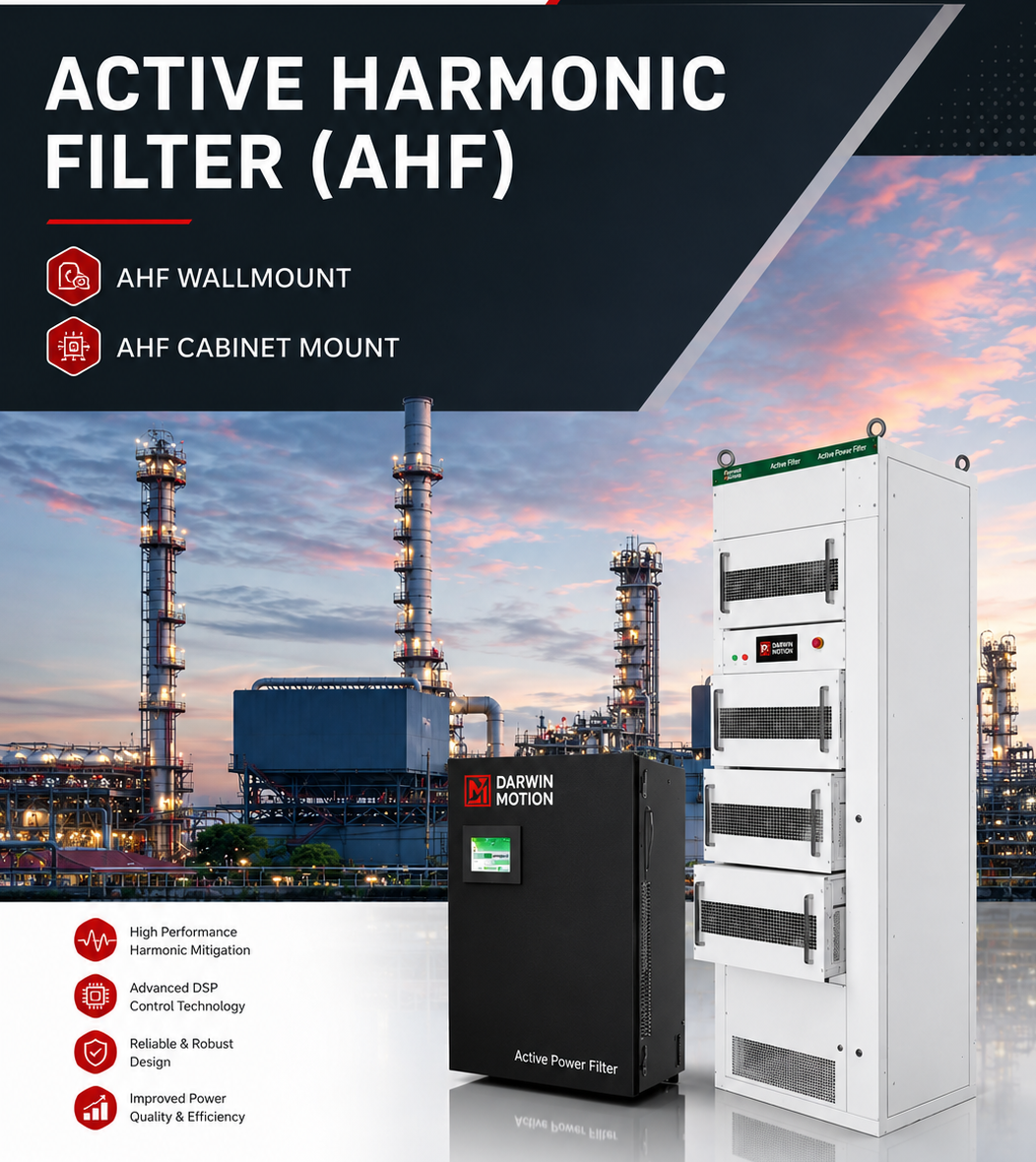
Power quality has become a major concern for modern industries as manufacturing facilities increasingly depend on variable frequency drives (VFDs), automation systems, UPS units, rectifiers, and other nonlinear electrical loads. Although these technologies improve productivity and operational efficiency, they can introduce harmonic distortion into electrical networks. Excessive harmonics may lead to overheating, equipment malfunction, increased energy losses, and reduced electrical system reliability.
To address these challenges, industries commonly use harmonic mitigation solutions such as active and passive harmonic filters. However, selecting the right technology depends on the electrical load profile, harmonic levels, operational requirements, and future expansion plans.
Understanding the difference between an Active Harmonic Filter and a Passive Harmonic Filter can help industries make informed decisions about power quality improvement. As a trusted Darwin Motion AC Drive manufacturer, Darwin Motion focuses on advanced industrial power quality and electrical drive solutions designed to support reliable and efficient industrial operations.
Harmonics are unwanted electrical frequency components that are multiples of the fundamental supply frequency. In a typical 50 Hz electrical system, harmonic frequencies include 100 Hz, 150 Hz, 250 Hz, 350 Hz, and higher-order components.
These distortions are generally generated by nonlinear loads that draw current in a non-sinusoidal waveform. Common industrial sources include:
When harmonic levels exceed acceptable limits, they can negatively affect electrical distribution systems and connected equipment.
A Passive Harmonic Filter is an electrical filtering arrangement that uses passive components such as capacitors, inductors, and resistors to reduce specific harmonic frequencies. These components are configured to provide a low-impedance path for selected harmonic currents, preventing them from circulating through the upstream electrical network.
Passive filters are generally designed for particular harmonic orders, such as the 5th, 7th, 11th, and 13th harmonics. Their performance depends on the filter design, electrical system impedance, and operating conditions.
An Active Harmonic Filter (AHF) is an advanced electronic power quality solution designed to dynamically compensate for harmonic currents generated by nonlinear electrical loads. Unlike passive filters, which use fixed electrical components, active filters use power electronic converters and intelligent control systems to monitor the electrical network and generate compensating currents.
The system continuously measures load current, identifies harmonic components, and injects an equal and opposite compensating current. This significantly reduces harmonic distortion in the supply network and helps maintain a cleaner electrical waveform.
The operation of an active filter involves a continuous monitoring and compensation process:
Both technologies help improve electrical power quality, but their working principles, flexibility, and suitability for industrial applications differ significantly.
| Comparison Parameter | Active Harmonic Filter | Passive Harmonic Filter |
|---|---|---|
| Working Principle | Electronic current injection | LC-based filtering |
| Harmonic Compensation | Multiple harmonic orders | Selected harmonic orders |
| Load Variation | Adapts dynamically | Less flexible |
| System Impedance | Generally less sensitive to system impedance variations | Can be significantly affected by system impedance |
| Resonance Risk | Does not introduce the same passive LC resonance risk | Potential resonance risk |
| Installation Cost | Generally higher initial investment | Generally lower initial investment |
| Maintenance | Requires electronic system monitoring and maintenance | Requires inspection of capacitors, inductors, and connections |
| Typical Applications | Dynamic and complex industrial loads | Stable and predictable harmonic loads |
The right choice depends on the electrical characteristics and operating conditions of the facility. There is no universal solution for every industrial application. However, understanding the requirements of different sectors can simplify the selection process.
Manufacturing and automotive plants use numerous VFDs, robotic systems, CNC machines, welding equipment, and automated production lines. These loads frequently change according to production requirements, resulting in fluctuating harmonic currents.
Recommended Solution: Active Harmonic Filters are generally more suitable for dynamic manufacturing environments because they can continuously adapt to changing load conditions.
Steel plants and metal processing facilities operate heavy-duty electrical equipment, drives, furnaces, and other nonlinear loads. These systems can produce significant harmonic distortion and place additional stress on transformers and electrical distribution networks.
Recommended Solution: Active harmonic compensation is a strong option where harmonic loads fluctuate. Passive filters may also be considered for stable, dedicated loads after a detailed system study.
Pharmaceutical and chemical manufacturing facilities depend on precision-controlled motors, pumps, compressors, HVAC systems, and automated process equipment. Maintaining reliable power quality is important for protecting sensitive electronic systems and ensuring uninterrupted production.
Recommended Solution: Active Harmonic Filters are often preferred for facilities with multiple variable-speed drives and changing process loads.
Food processing facilities use conveyors, refrigeration systems, packaging machines, compressors, pumps, and automated production equipment. The combination of these electrical loads can generate harmonics that affect overall power quality.
Recommended Solution: Active filters offer flexibility for plants with varying production schedules and changing electrical demand.
Textile mills, extrusion plants, injection moulding units, and plastic processing facilities frequently use AC drives to control motor speed and improve production efficiency. These applications can introduce harmonic distortion into the electrical network.
Recommended Solution: Active harmonic compensation is particularly useful where multiple drives operate under varying load conditions. Passive filtering may be suitable for dedicated applications with stable harmonic characteristics.
Before investing in a harmonic mitigation system, industries should conduct a proper electrical assessment. Selecting a filter based only on its rated capacity may not deliver the expected results.
Measure Total Harmonic Distortion (THD) and identify the dominant harmonic orders in the electrical network. A power quality audit helps determine the actual compensation requirements.
Evaluate whether the industrial load remains constant or changes throughout the production cycle. Dynamic loads generally benefit from active compensation.
Consider transformer ratings, short-circuit capacity, cable sizing, distribution architecture, and available installation space.
If additional machinery, VFDs, or automation systems are planned, choose a harmonic mitigation solution that can accommodate future electrical requirements.
Evaluate the installation against relevant power quality requirements, including IEEE 519 where applicable, along with local utility and regulatory requirements.
Choosing the right power quality technology requires more than selecting an electrical product. Industries need solutions that address their actual operating conditions, improve system reliability, and support long-term performance.
Darwin Motion AC Drive manufacturer is focused on industrial drive and power quality solutions that support modern manufacturing and infrastructure requirements. With an understanding of industrial electrical applications, Darwin Motion aims to help businesses address power quality challenges and improve operational efficiency.
Businesses looking for advanced harmonic mitigation technology can explore the Active Harmonic Filter solutions from Darwin Motion to understand their potential applications and benefits.
Both active and passive harmonic filters play an important role in improving industrial power quality. Passive harmonic filters are a practical and economical option for applications with stable loads and predictable harmonic characteristics. On the other hand, active harmonic filters provide greater flexibility, dynamic compensation, and the ability to address multiple harmonic frequencies in installations with changing electrical loads.
For modern industries that rely heavily on VFDs, automation, and variable-speed machinery, active harmonic filtering is often a more adaptable long-term solution. Nevertheless, the final selection should always be based on harmonic measurements, electrical system studies, and application requirements.
As a Darwin Motion AC Drive manufacturer, Darwin Motion supports industries in exploring modern drive and power quality technologies. Choosing the right harmonic solution can help reduce electrical disturbances, protect valuable equipment, and create a more reliable industrial power distribution system.
An Active Harmonic Filter uses power electronics to dynamically inject compensating current, whereas a Passive Harmonic Filter uses capacitors and inductors to filter selected harmonic frequencies.
An Active Harmonic Filter is generally more suitable for industries with fluctuating loads and multiple harmonic frequencies. Passive filters can be more economical for stable loads with predictable harmonic characteristics.
Yes. Active Harmonic Filters are commonly used in installations with multiple Variable Frequency Drives to reduce harmonic currents generated by nonlinear drive loads.
Harmonic filters can reduce unnecessary electrical losses associated with harmonic currents and help improve overall electrical system performance. Actual energy savings depend on the installation and load conditions.
Steel, automotive, pharmaceutical, textile, food processing, chemical, plastic processing, and manufacturing industries can benefit from active harmonic compensation, particularly where nonlinear loads vary frequently.
The required capacity should be determined through a power quality study that evaluates harmonic current levels, load variations, system configuration, and the desired compensation performance.
You can visit the Active Harmonic Filter page on the Darwin Motion website to explore the available industrial power quality solution.


