Posted on 25th Nov 2026
Modern industrial electrical systems depend on Variable Frequency Drives (VFDs), AC Drives, servo motors, UPS systems, rectifiers, and other power electronic equipment. Although these technologies improve productivity and operational efficiency, they can generate harmonic distortion that negatively affects electrical power quality.
Harmonic distortion can cause transformer overheating, increased electrical losses, poor power factor, equipment malfunction, and unexpected production downtime. To overcome these challenges, industries increasingly adopt advanced power quality solutions.
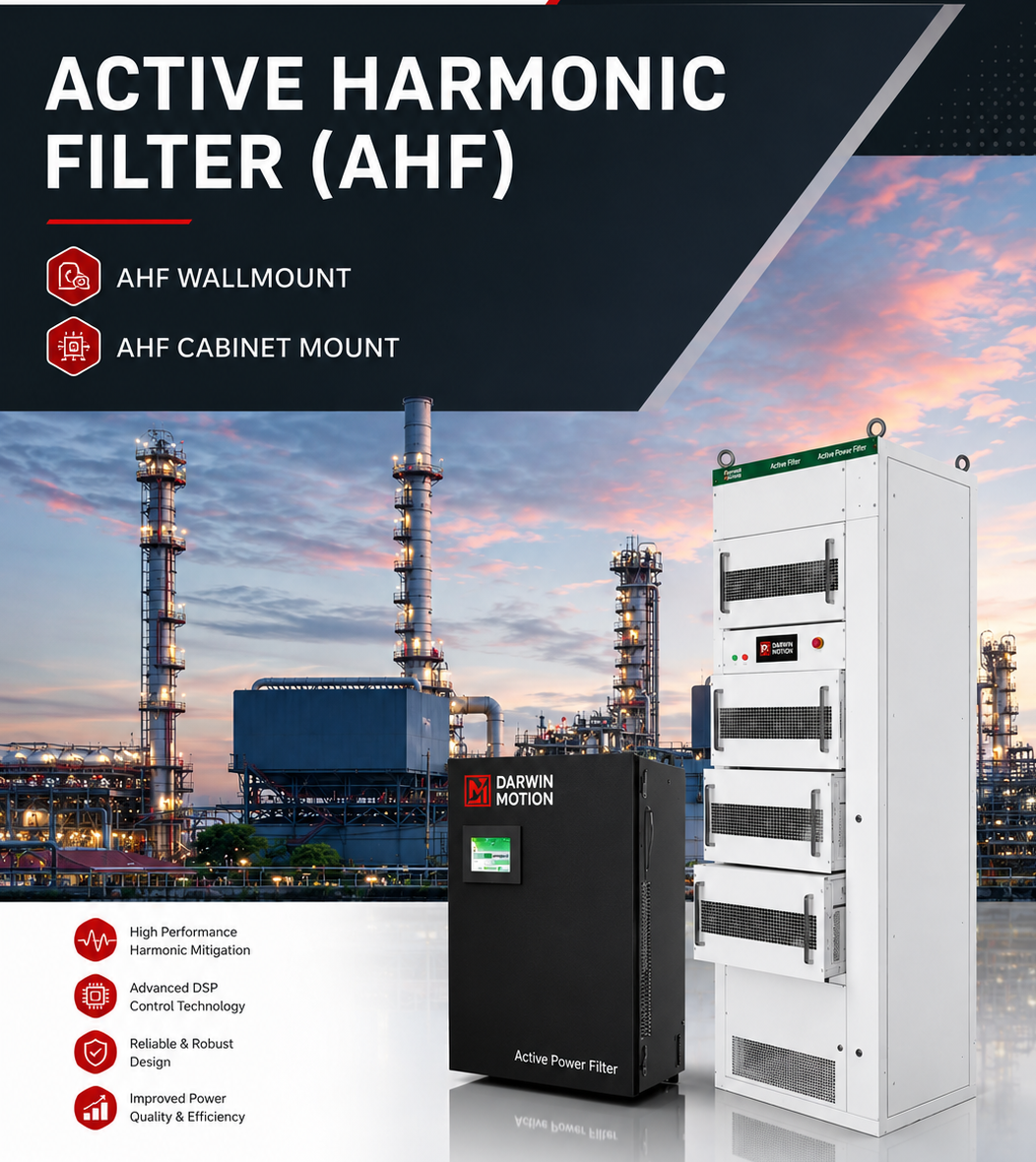
An Active Harmonic Filter is an intelligent electrical device that continuously monitors harmonic currents and injects compensating currents into the electrical network to reduce unwanted harmonics.
As a trusted Darwin Motion AC Drive Manufacturer, Darwin Motion provides advanced industrial automation and power quality solutions designed to improve electrical system reliability, reduce harmonic distortion, and support efficient industrial operations.
An Active Harmonic Filter (AHF) is a power electronic device designed to detect, analyze, and compensate for harmonic currents generated by nonlinear electrical loads.
Unlike conventional passive harmonic filters that generally operate at specific tuned frequencies, an active filter uses intelligent digital control technology and power electronic converters to dynamically compensate for multiple harmonic frequencies.
The filter continuously measures electrical current, identifies unwanted harmonic components, and generates equal and opposite compensating currents. These currents counteract the harmonic currents produced by nonlinear loads, helping maintain a cleaner electrical current waveform.
Harmonics occur when electrical equipment draws current in a distorted waveform instead of a smooth sinusoidal waveform. Equipment that produces this behavior is commonly known as nonlinear loads.
Common industrial sources of harmonic distortion include:
When multiple nonlinear loads operate simultaneously, their harmonic currents can increase distortion throughout the electrical distribution network.
The working principle of an Active Harmonic Filter is based on real-time harmonic detection, digital signal processing, and current injection technology.
The system identifies unwanted harmonic currents generated by nonlinear loads and injects compensating currents with corresponding harmonic components in opposite phase. This reduces the harmonic current supplied by the electrical source.
The first step involves continuously measuring the electrical current using Current Transformers (CTs) or suitable current sensors.
These sensors monitor the current flowing through the electrical network and provide measurement signals to the filter's digital control system. The collected information helps identify the overall load current waveform and its harmonic content.
After measuring the current, the internal Digital Signal Processor (DSP) analyzes the electrical waveform and separates the fundamental current component from unwanted harmonic components.
Advanced control algorithms calculate the magnitude, frequency, and phase angle of the harmonic currents that require compensation.
This information allows the filter to determine the appropriate compensating current required under changing load conditions.
Once harmonic components are identified, the filter uses a power electronic converter, typically based on IGBT switching technology, to generate the required compensating current.
The generated current contains harmonic components with approximately equal magnitudes and opposite phase angles compared with the unwanted load harmonics.
The converter controls its output current using high-speed switching and an appropriate control algorithm.
The generated compensating current is injected into the electrical distribution system through the filter's coupling arrangement.
The injected current opposes the harmonic current generated by nonlinear loads. As a result, the harmonic current drawn from the power source is reduced.
This process is called harmonic current cancellation or active harmonic compensation.
The electrical load conditions in industrial facilities frequently change due to machinery starting, stopping, and operating at different speeds.
An Active Harmonic Filter continuously monitors these variations and automatically adjusts its compensation current to maintain improved power quality.
Current injection is the most important operating principle behind active harmonic filtering technology.
To understand this concept, consider an industrial facility operating several Variable Frequency Drives. These drives generate harmonic currents that distort the current waveform supplied by the electrical source.
The Active Harmonic Filter detects the unwanted harmonic components and injects an opposing current into the electrical network. This injected current compensates for the harmonic currents generated by the connected equipment.
The basic mathematical relationship can be represented as:
I Source = I Load + I Filter
Where:
The filter controls its output so that its harmonic current components oppose those generated by the load.
For example, if a nonlinear load generates a particular harmonic current component of 20 amperes, the filter aims to inject approximately 20 amperes of that harmonic component in the opposite phase.
Consequently, the upstream electrical source supplies significantly less of that harmonic current.
Power electronic components are essential for generating accurate and dynamic compensating currents. Modern active filters use advanced semiconductor switching devices and intelligent control systems to achieve fast harmonic compensation.
Both active and passive harmonic filters are used to reduce harmonic distortion. However, they operate using different technologies and offer different compensation capabilities.
Installing an appropriately selected Active Harmonic Filter can improve electrical power quality and support the reliable operation of industrial equipment.
Active harmonic compensation reduces unwanted harmonic currents and helps maintain a cleaner electrical current waveform. This can improve the performance of industrial electrical distribution systems.
Certain Active Harmonic Filter configurations also provide reactive power compensation. This can help improve the overall power factor and reduce unnecessary reactive power demand.
Lower harmonic currents can reduce additional heating and electrical losses in transformers, cables, and other distribution components.
Reducing excessive harmonic distortion helps minimize electrical stress on transformers, motors, capacitors, and other connected equipment.
Improved power quality can help reduce harmonic-related disturbances, nuisance tripping, and unexpected equipment interruptions.
Active filters continuously monitor the electrical network and adjust their compensation according to changing industrial load requirements.
Active Harmonic Filters are suitable for industrial and commercial facilities where nonlinear electrical loads generate significant harmonic distortion.
Choosing the right power quality equipment manufacturer is essential for maintaining reliable industrial electrical operations.
Darwin Motion AC Drive Manufacturer focuses on advanced industrial automation, motor control, and power quality technologies designed to meet modern industrial requirements.
Darwin Motion provides advanced Active Harmonic Filter solutions that continuously monitor electrical networks and inject compensating currents to reduce harmonic distortion.
Darwin Motion also offers multiple power quality solutions, including Active Harmonic Filters, Static VAR Generators (SVG), Dynamic Voltage Restorers (DVR), Unified Power Quality Controllers (UPQC), and industrial AC Drives.
By combining industrial drive technology with advanced power quality solutions, Darwin Motion supports industries in improving electrical system performance, reducing harmonic distortion, and enhancing operational reliability.
Explore the product range here: Darwin Motion Active Harmonic Filter Solutions .
Selecting an appropriate Active Harmonic Filter requires a detailed understanding of the electrical system and its harmonic characteristics.
A professional power quality assessment helps determine the correct filter capacity and installation arrangement.
The working principle of an Active Harmonic Filter is based on intelligent harmonic detection, digital signal processing, and real-time current injection. By generating compensating currents that oppose unwanted harmonic currents, the filter reduces harmonic distortion and improves electrical power quality.
For modern industries operating AC Drives, VFDs, UPS systems, rectifiers, and other nonlinear electrical equipment, active harmonic compensation is an important technology for maintaining reliable electrical infrastructure.
Darwin Motion AC Drive Manufacturer offers advanced Active Harmonic Filter solutions designed to support harmonic mitigation, reactive power compensation, and three-phase load balancing. With intelligent control technology and dynamic compensation capabilities, Darwin Motion helps industries move toward more efficient and reliable electrical operations.
An Active Harmonic Filter continuously monitors electrical current, identifies unwanted harmonic components, and injects equal and opposite compensating currents to reduce harmonic distortion.
Current injection is the process of supplying compensating harmonic currents into an electrical network. These currents oppose the harmonic components generated by nonlinear loads, reducing the harmonic current drawn from the power source.
Yes. Many modern Active Harmonic Filters provide reactive power compensation in addition to harmonic mitigation, helping improve power factor when correctly configured.
Automotive, steel, cement, textile, pharmaceutical, food processing, data center, water treatment, and other industries operating nonlinear electrical loads can benefit from Active Harmonic Filters.
An Active Harmonic Filter uses electronic converters and intelligent control to dynamically compensate multiple harmonic frequencies. A passive filter generally uses tuned electrical components to target selected harmonic frequencies.
Darwin Motion provides industrial power quality solutions featuring real-time harmonic compensation, reactive power support, three-phase load balancing, and intelligent digital control technology.
The achievable THDi depends on the electrical system, nonlinear load characteristics, filter capacity, and installation arrangement. Darwin Motion lists THDi reduction to below 5% among its product specifications, subject to application conditions.


