Posted on 28th Aug 2026
The pharmaceutical industry depends on highly reliable electrical systems to maintain continuous production, precise process control, and consistent product quality. Modern pharmaceutical manufacturing facilities use a wide range of power electronic and non-linear loads, including Variable Frequency Drives (VFDs), HVAC systems, UPS systems, servo drives, compressors, pumps, automated production equipment, laboratory systems, and packaging machinery. These loads can introduce harmonic currents into the electrical network.
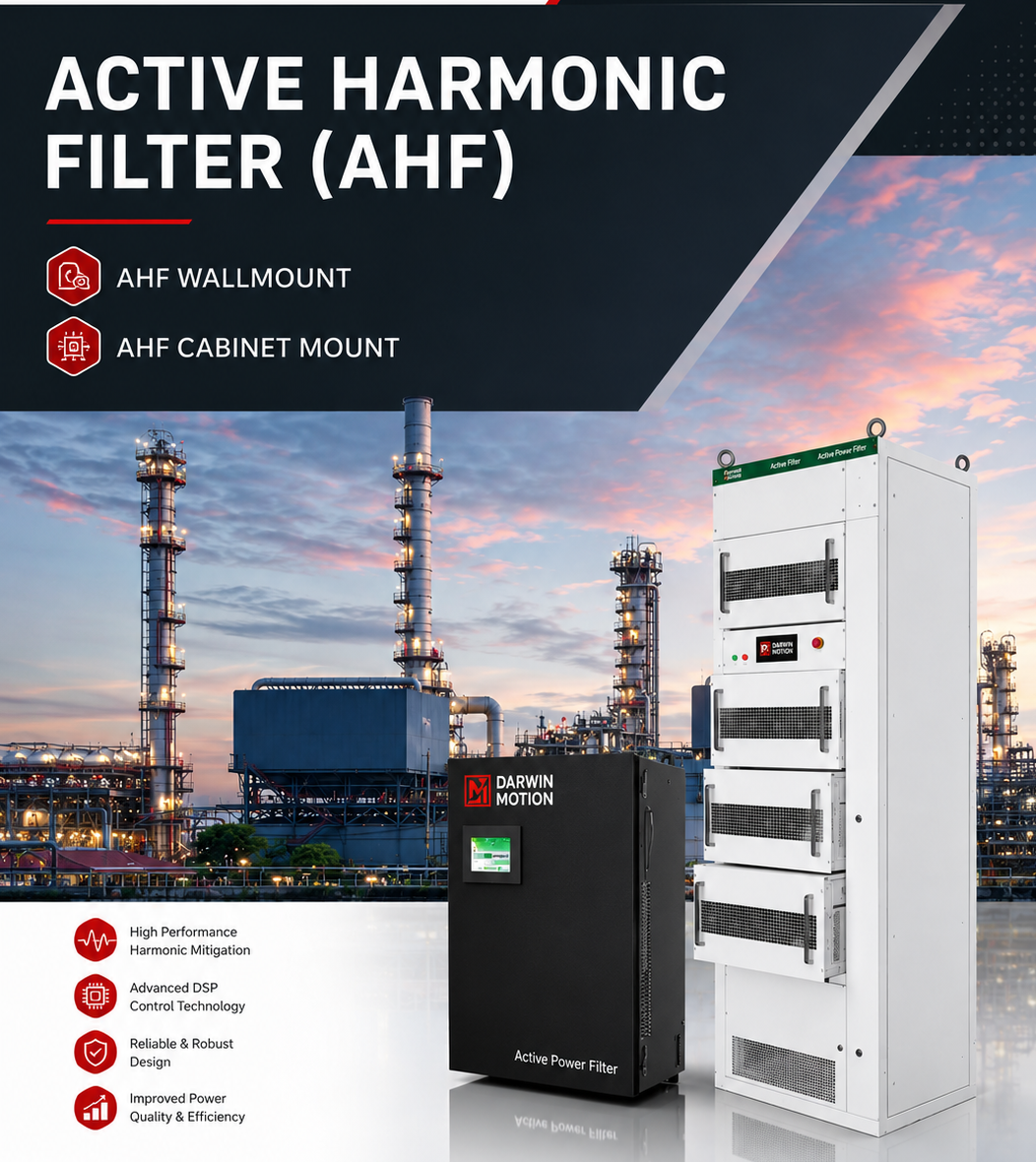
A properly designed Harmonic Filter for Pharmaceutical Industry can help reduce harmonic distortion, improve power quality, minimize electrical losses, and support reliable operation of critical plant equipment. Darwin Motion, a leading AC Drive manufacturer and power quality solution provider, offers Active Harmonic Filter (AHF) technology designed for demanding industrial applications, including pharmaceutical plants.
Pharmaceutical manufacturing facilities often operate sensitive electrical and automation equipment continuously. Any deterioration in power quality can affect production reliability, equipment performance, and maintenance requirements.
Harmonics are electrical components whose frequencies are integer multiples of the fundamental power frequency. They are commonly generated by non-linear loads such as VFDs, UPS systems, switching power supplies, and other power electronic converters. Harmonic currents can contribute to transformer and cable heating, additional losses, equipment stress, and power quality problems.
A harmonic filter is a power quality device designed to reduce unwanted harmonic currents and improve the quality of electrical power. Depending on the application, harmonic mitigation can be achieved using passive filters, active harmonic filters, or hybrid solutions.
For pharmaceutical facilities with rapidly changing loads and multiple sources of harmonics, an Active Harmonic Filter can provide dynamic compensation. Active filters continuously monitor the electrical network and generate compensation currents that counteract harmonic components produced by non-linear loads.
An Active Harmonic Filter (AHF) is particularly useful where the electrical load changes frequently. Instead of being designed around a fixed harmonic profile, an active filter continuously measures the electrical system and dynamically adjusts its compensation.
Darwin Motion's Active Harmonic Filter uses real-time monitoring and digital control to identify harmonic components and inject equal and opposite compensation currents. According to Darwin Motion's published specifications, its AHF can compensate harmonic orders from 2nd to 50th and is designed for fast dynamic response.
Harmonic mitigation helps maintain cleaner electrical waveforms throughout the facility. Improved power quality can support more stable operation of sensitive automation, control, instrumentation, and production equipment.
Excessive harmonic currents can increase losses and heating in transformers, cables, switchgear, and other electrical components. Harmonic filtering can help reduce these unwanted effects and improve the utilization of electrical infrastructure.
Pharmaceutical plants depend on automation, HVAC, pumps, compressors, drives, and other electrically powered systems. Reducing harmonic distortion can help minimize electrical stress and support longer equipment operating life.
Modern Active Harmonic Filters can provide reactive power compensation in addition to harmonic mitigation. Darwin Motion's AHF specifications indicate power-factor improvement capability up to 0.99, depending on the application and system conditions.
Unexpected electrical problems can interrupt critical manufacturing processes. By improving power quality and reducing harmonic-related electrical disturbances, harmonic filtering can contribute to improved system reliability and reduced nuisance trips.
Harmonic currents contribute to additional losses within electrical distribution equipment. Reducing unnecessary harmonic currents can improve the overall electrical performance of a facility and help optimize the use of installed electrical infrastructure.
IEEE 519 provides guidance and requirements for controlling harmonics in electric power systems. The standard establishes power quality goals for systems containing linear and non-linear loads and addresses voltage and current distortion at the Point of Common Coupling (PCC).
For pharmaceutical facilities, harmonic analysis should therefore consider the complete electrical network, including the utility supply, transformers, generators, VFDs, UPS systems, distribution panels, and other non-linear loads. Filter selection should be based on actual system measurements and engineering calculations rather than a one-size-fits-all approach.
Darwin Motion is an established AC Drive manufacturer and provider of industrial power quality solutions. Its product portfolio includes Active Harmonic Filters, Static Var Generators, Unified Power Quality Controllers, Dynamic Voltage Restorers, and Variable Frequency Drives.
The company's Active Harmonic Filter is designed for industrial applications where electrical loads can vary significantly. Darwin Motion states that its AHF supports real-time harmonic compensation, reactive power compensation, three-phase load balancing, and modular installation options.
A harmonic filter can be installed at different levels of a pharmaceutical plant's electrical distribution system depending on the harmonic source and the required performance.
| Feature | Active Harmonic Filter | Passive Harmonic Filter |
|---|---|---|
| Compensation | Dynamic and real-time | Generally fixed |
| Load Variation | Automatically adapts | Limited adaptability |
| Multiple Harmonic Orders | Can compensate multiple harmonic orders | Typically designed for selected frequencies |
| Resonance Consideration | No passive tuning resonance issue | System design must consider resonance |
| Application | Dynamic and complex electrical systems | Suitable for predictable harmonic profiles |
The appropriate technology depends on the electrical network, harmonic spectrum, load profile, available capacity, and project requirements. A detailed power quality study should be performed before selecting the final filter configuration.
Measure voltage, current, harmonic spectrum, THD, load profile, power factor, and other relevant electrical parameters at appropriate points in the facility.
Determine which loads are responsible for the majority of harmonic current. Typical sources include VFDs, UPS systems, HVAC drives, compressors, pumps, and automation equipment.
The filter rating should be selected according to the measured harmonic current and the expected future expansion of the plant. Darwin Motion lists AHF compensation capacities from 30A to 600A for its published product range.
Pharmaceutical manufacturing facilities may add production lines, HVAC capacity, automation systems, or additional process equipment over time. A modular harmonic filtering solution can provide greater flexibility for future expansion.
After installation, harmonic measurements should be taken again to verify the performance of the system and evaluate compliance with the applicable power-quality requirements.
Maintaining reliable power quality is essential for modern pharmaceutical manufacturing facilities. With increasing use of VFDs, UPS systems, automation, HVAC equipment, compressors, pumps, and other non-linear loads, harmonic distortion can become an important electrical-system challenge.
A properly engineered Harmonic Filter for Pharmaceutical Industry can help reduce harmonic distortion, improve power quality, reduce electrical losses, protect critical equipment, and enhance the reliability of the plant's electrical infrastructure.
As an experienced AC Drive manufacturer and power quality solution provider, Darwin Motion offers Active Harmonic Filter technology designed for industrial applications. Its AHF portfolio provides real-time harmonic compensation, reactive power compensation, load balancing, and modular scalability for demanding electrical systems.
For pharmaceutical manufacturers looking to improve electrical power quality, reduce harmonic distortion, and build a more reliable power distribution system, Darwin Motion Active Harmonic Filter solutions can be considered as part of a professionally engineered harmonic mitigation strategy.
A Harmonic Filter for Pharmaceutical Industry is a power quality solution designed to reduce harmonic distortion generated by non-linear electrical loads commonly used in pharmaceutical manufacturing facilities.
Pharmaceutical facilities often operate sensitive automation, HVAC, UPS, instrumentation, and motor-drive systems. Harmonics can increase electrical losses, heating, and equipment stress and may contribute to power quality problems.
Yes. Active Harmonic Filters are commonly used to compensate harmonic currents associated with VFDs and other power electronic loads. Darwin Motion specifically lists VFDs among the applications for its Active Harmonic Filter.
Yes. Darwin Motion offers Active Harmonic Filter solutions as part of its power quality product portfolio, alongside AC Drives and other industrial power quality technologies.
A power quality assessment should normally examine harmonic spectrum, THD, load profile, transformer capacity, short-circuit characteristics, power factor, existing compensation equipment, and the location of the Point of Common Coupling.


