Posted on 21st Aug 2026
Steel plants operate some of the most power-intensive electrical systems in the industrial sector. Electric arc furnaces, induction furnaces, rolling mills, compressors, pumps, fans, cooling systems and other electrically driven equipment can create significant power-quality challenges. Non-linear loads such as variable frequency drives (VFDs), furnaces and power-electronic converters can introduce harmonic currents into the electrical network.
For modern steel manufacturing facilities, controlling these harmonics is essential for maintaining reliable plant operation, protecting electrical equipment and improving overall power-system performance. A properly engineered Harmonic Filter for Steel Plant can help mitigate harmonic distortion and provide cleaner electrical power for critical industrial loads.
Steel manufacturing processes often involve large and rapidly changing electrical loads. Electric arc furnaces and other nonlinear equipment can contribute significant harmonic distortion, while rolling mills and auxiliary systems may use high-power AC drives and other power-electronic equipment.
Research and field studies of steel plants have identified harmonics and power-quality disturbances at the point of common coupling (PCC) as important considerations in steel-plant electrical-system design.
Without appropriate harmonic mitigation, excessive distortion can contribute to transformer and cable heating, equipment stress, nuisance tripping, increased losses and reduced electrical-system reliability.
Steel-plant power-quality studies specifically identify arc furnaces, adjustable-speed drives and cycloconverters among the loads that can contribute to harmonic distortion.
A harmonic filter is an electrical power-quality solution designed to reduce unwanted harmonic currents and improve the quality of power within an industrial electrical network. Depending on the application, harmonic mitigation may be achieved using passive filters, active harmonic filters, harmonic-mitigating equipment, or a combination of technologies.
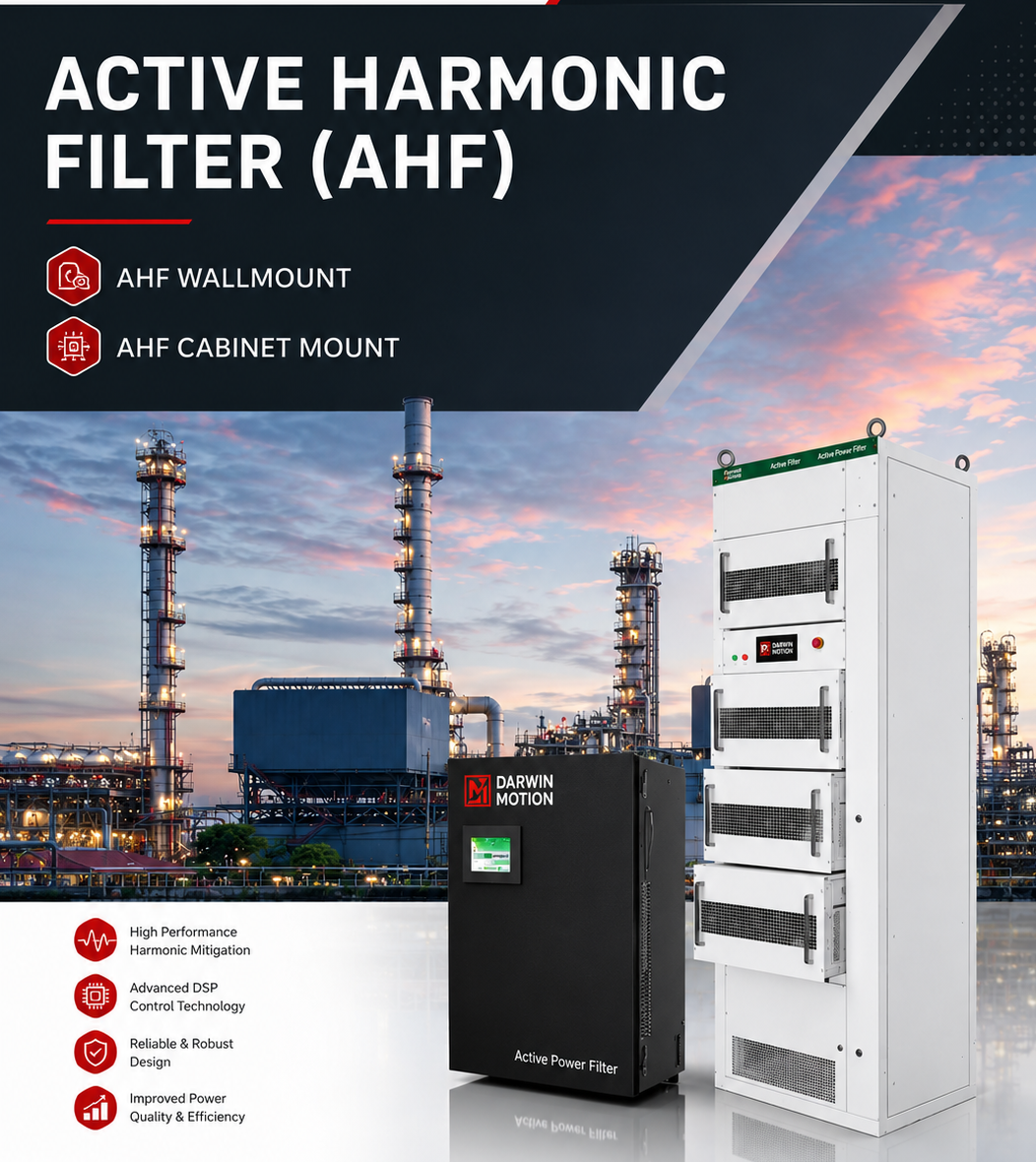
An Active Harmonic Filter (AHF) continuously monitors the electrical system and generates compensating currents to counteract harmonic currents produced by nonlinear loads. This makes active filtering particularly useful for facilities where load conditions change frequently.
Steel plants can experience highly dynamic electrical loads. Furnace operation, rolling-mill processes and other production stages can cause the harmonic profile of the electrical system to change over time. An active harmonic filter can respond dynamically to these changing conditions and help maintain improved power quality.
Darwin Motion offers power-quality and industrial automation solutions designed around the requirements of modern industrial facilities. The company provides AC drives and related technologies for improving energy efficiency, reliability and industrial performance.
Installing an appropriately engineered harmonic-filtering solution can provide several operational benefits for steel manufacturing facilities.
The primary objective of harmonic filtering is to reduce unwanted harmonic currents and help maintain cleaner power throughout the plant electrical network. This can be particularly important where multiple nonlinear loads operate simultaneously.
Better harmonic control can contribute to improved power quality at plant buses and the point of common coupling. This helps create a more stable electrical environment for motors, drives, transformers, automation systems and other equipment.
Excessive harmonics can increase electrical losses and heating in transformers, cables, motors and other components. Darwin Motion notes that harmonic distortion associated with VFDs can contribute to power-quality problems, increased losses and equipment heating.
Controlling harmonics can reduce unnecessary electrical stress on plant equipment. This may support longer equipment service life and help reduce maintenance requirements when the filtering solution is correctly designed for the application.
Harmonic currents can contribute to additional losses within electrical distribution systems. Reducing unnecessary harmonic current can help improve the overall efficiency of the plant's electrical infrastructure.
Unexpected trips and power-quality disturbances can interrupt production processes. Harmonic mitigation can help create a cleaner electrical environment for critical equipment and support more reliable plant operation.
Rolling mills commonly use high-power motors and AC drives for controlling production equipment. VFD-based systems provide valuable speed and torque control, but their power-electronic input stages can contribute harmonic currents to the electrical network.
A suitable harmonic-filtering solution can therefore be integrated with rolling-mill electrical systems to help control harmonic distortion while maintaining the performance advantages of AC drive technology.
Darwin Motion AC Drive solutions are designed for industrial automation applications where precise motor control, energy efficiency and reliable operation are important. Darwin Motion identifies iron and steel among the industries served by its drive technology portfolio.
Combining appropriate AC drive technology with a properly engineered harmonic-mitigation strategy can provide a comprehensive approach to improving electrical performance in steel plants.
Darwin Motion is an AC Drive manufacturer focused on industrial automation and energy-efficient drive solutions. Its technology portfolio includes industrial drives and power-quality solutions intended to support factories and industrial applications.
Darwin Motion states that its engineering team has extensive experience in automation technology and that its products and solutions are developed to improve energy efficiency, asset reliability, productivity, safety and performance.
There is no single harmonic-filter rating that is suitable for every steel plant. The correct solution should be selected after evaluating the plant's electrical network, nonlinear loads and operating conditions.
Before selecting a filter, harmonic measurements should ideally be performed at relevant points in the electrical system, particularly at the PCC and major load buses. Measurement data can help identify the dominant harmonic orders, loading conditions and the required compensation capacity.
Steel-mill power-quality studies use measurements at the PCC to evaluate harmonic distortion, power factor and other electrical parameters and to support the design of harmonic-mitigation systems.
IEEE 519 is widely referenced when evaluating harmonic distortion at the point of common coupling. Steel-plant harmonic studies have specifically considered harmonic-filter designs with the objective of controlling harmonic levels at the PCC in accordance with IEEE 519 requirements.
However, compliance should always be evaluated against the actual electrical-system configuration, measurement results, utility requirements and applicable edition of the standard. Filter selection should therefore be based on an engineering assessment rather than a generic filter rating.
Both active and passive filtering technologies can be useful depending on the application. Passive filters use tuned components to provide a low-impedance path for selected harmonic frequencies, while active harmonic filters use power electronics to generate compensating currents.
For highly dynamic steel-plant loads, the appropriate technology should be determined through a detailed power-quality study and application assessment.
A reliable electrical system is essential for maintaining productivity and operational continuity in a steel plant. With high-power furnaces, rolling mills, VFDs and other nonlinear loads operating together, harmonic distortion can become a significant power-quality concern.
A properly engineered Harmonic Filter for Steel Plant can help reduce harmonic distortion, improve power quality, protect electrical equipment and support efficient plant operation.
Darwin Motion, as an AC Drive manufacturer and industrial automation technology provider, offers Active Harmonic Filter and AC Drive solutions for demanding industrial applications. For steel manufacturers looking to improve power quality and address harmonic-related challenges, Darwin Motion can be considered as a technology partner for application-specific harmonic mitigation solutions.
A Harmonic Filter for Steel Plant is a power-quality solution used to mitigate harmonic currents generated by nonlinear loads such as furnaces, VFDs, rectifiers and other power-electronic equipment used in steel manufacturing.
Steel plants can contain large nonlinear and rapidly changing loads. Harmonics may increase electrical losses and heating, affect sensitive equipment and contribute to power-quality problems.
Yes. Active Harmonic Filters can be applied to electrical systems containing VFDs and other nonlinear loads. The appropriate configuration and rating should be determined from actual system measurements and load characteristics.
Yes. Darwin Motion is an industrial automation technology provider with AC Drive and related drive-system solutions for industrial applications.
The selection should be based on parameters such as plant load, transformer capacity, voltage level, PCC characteristics, harmonic measurements, dominant harmonic orders, VFD capacity, furnace operation and the required power-quality performance.
If your steel plant is experiencing high THD, transformer heating, nuisance trips, equipment stress or other power-quality issues, a detailed harmonic assessment can help identify the appropriate mitigation strategy.
Explore Darwin Motion Active Harmonic Filter solutions for industrial power-quality applications:


