Posted on 12th Nov 2026
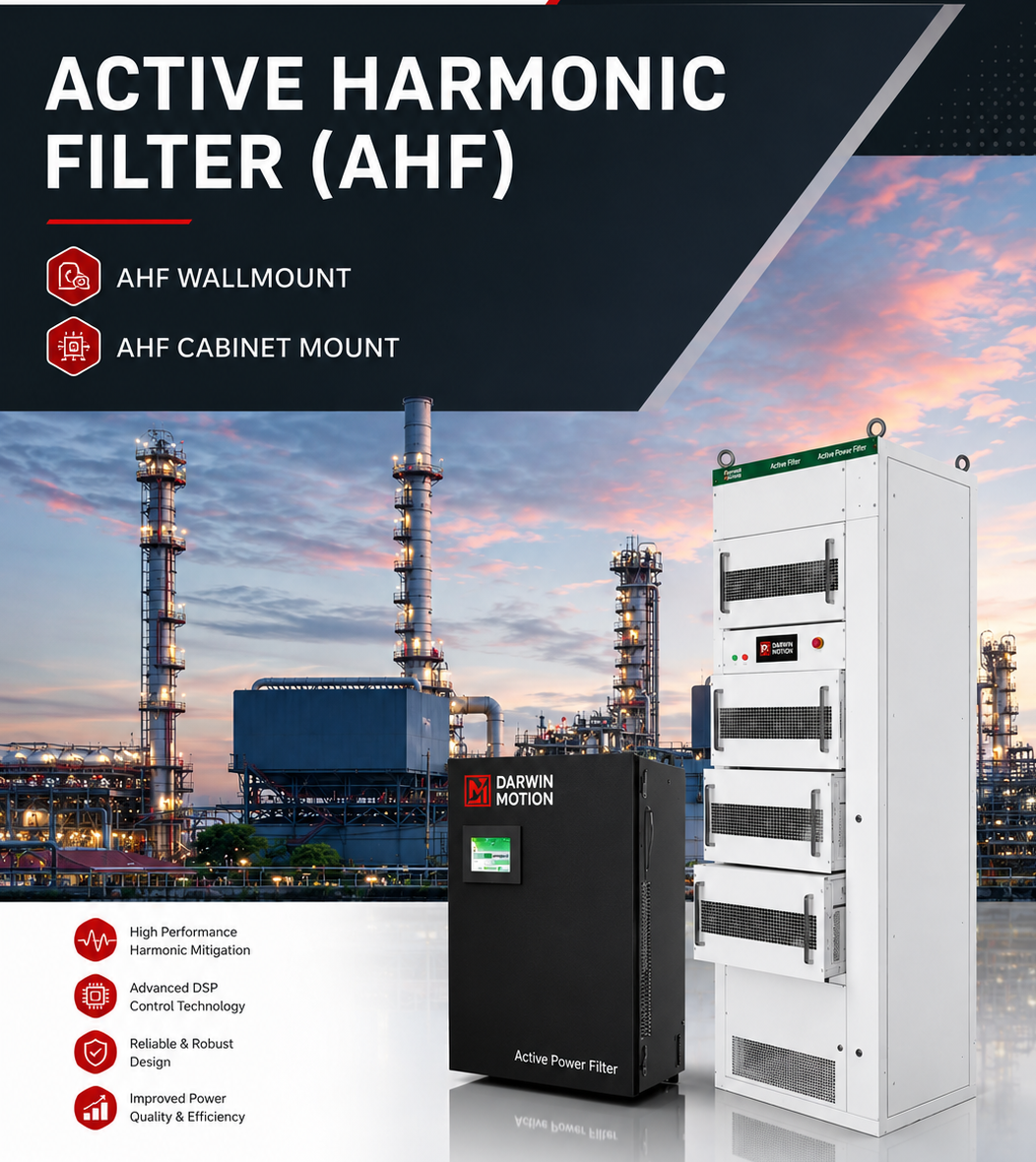
In modern industrial environments, maintaining electrical power quality is essential for ensuring efficient operations, protecting electrical equipment, and reducing energy losses. Industries increasingly depend on Variable Frequency Drives (VFDs), AC Drives, servo drives, UPS systems, automation equipment, and other power electronic devices. Although these technologies improve productivity and operational efficiency, they can introduce unwanted electrical harmonics into the power distribution system.
Excessive harmonic distortion can cause transformer overheating, motor performance issues, increased electrical losses, capacitor failures, and unexpected equipment shutdowns.
One of the most effective solutions for controlling these problems is an Active Harmonic Filter.
Darwin Motion AC Drive Manufacturer provides advanced power quality solutions designed to reduce harmonic distortion, improve electrical efficiency, and enhance industrial system reliability.
Harmonic distortion occurs when electrical current or voltage deviates from its ideal sinusoidal waveform. It is commonly generated by nonlinear electrical loads that consume current in an irregular manner.
Unlike traditional electrical equipment, modern electronic devices use switching circuits and power converters that can introduce harmonic frequencies into the electrical network.
Several industrial and commercial devices contribute to harmonic distortion, including:
When multiple nonlinear loads operate simultaneously, harmonic currents can accumulate and negatively affect the overall electrical distribution system.
Controlling harmonic distortion is important for maintaining reliable electrical infrastructure and improving industrial productivity. Excessive harmonics can create several operational challenges.
Harmonic currents increase additional heating in transformers, potentially reducing their operational life and efficiency.
Electrical harmonics increase losses in cables, transformers, motors, and other electrical components, affecting overall energy efficiency.
Harmonic frequencies can interact with capacitor banks and create resonance conditions, potentially resulting in overheating and premature capacitor failure.
Harmonic distortion can contribute to additional motor heating, vibration, torque pulsations, and reduced operating efficiency.
Excessive harmonics can interfere with sensitive electronic equipment, protection devices, and industrial automation systems, resulting in unwanted tripping and production interruptions.
An Active Harmonic Filter (AHF) is an advanced electronic power quality device designed to identify and compensate unwanted harmonic currents in real time.
Unlike conventional passive filters, which are generally designed for specific harmonic frequencies, active filters continuously monitor the electrical system and automatically respond to changing load conditions.
The working process involves the following steps:
The filter uses current sensors to continuously monitor the electrical current flowing through the system.
Advanced digital signal processing identifies unwanted harmonic components present in the current waveform.
The filter generates compensating currents with equal magnitude and opposite polarity to the detected harmonic components.
These compensating currents are injected into the electrical network, reducing unwanted harmonic currents.
The resulting current waveform becomes closer to an ideal sinusoidal waveform, improving the overall electrical performance.
Installing an appropriately selected Active Harmonic Filter offers several benefits for industrial and commercial electrical systems.
Active harmonic filtering helps reduce Total Harmonic Distortion (THD), improving the quality of electrical power supplied to connected equipment.
Advanced active harmonic filters can provide reactive power compensation, helping improve the overall power factor and reduce unnecessary reactive power demand.
By minimizing harmonic currents, active filters can help reduce additional losses in transformers, cables, and electrical distribution equipment.
Reduced electrical stress and overheating help protect transformers, motors, generators, and other sensitive electrical components.
Stable power quality helps minimize unexpected equipment failures, electrical disturbances, and production interruptions.
Active harmonic filters automatically adjust their compensation according to changing electrical loads, making them suitable for modern industries with varying operating conditions.
Selecting the right manufacturer is essential for achieving effective harmonic mitigation and long-term electrical system reliability.
Darwin Motion AC Drive Manufacturer specializes in industrial automation and advanced power quality solutions designed for demanding industrial applications.
Darwin Motion offers intelligent Active Harmonic Filter technology that continuously monitors electrical networks and compensates unwanted harmonics to improve overall power quality.
These features make Darwin Motion's harmonic filtering solutions suitable for industrial facilities looking to improve electrical performance and operational reliability.
Active harmonic filters are widely used in industries where nonlinear electrical loads operate continuously.
Manufacturing facilities use multiple VFDs, motors, automation equipment, and electronic control systems. Active harmonic filters help improve power quality and protect critical electrical infrastructure.
Textile machinery uses variable-speed drives and electronic control systems that can generate harmonic distortion. Harmonic compensation helps maintain stable electrical performance.
Heavy industrial machinery, rectifiers, and motor drives can introduce significant harmonic currents. Active filtering helps improve the reliability of electrical distribution networks.
Pharmaceutical production requires reliable electrical power for sensitive automation systems, production machinery, and environmental control equipment.
Data centers operate UPS systems, server equipment, cooling systems, and other nonlinear loads. Harmonic mitigation helps support reliable power distribution.
Processing lines, packaging machinery, compressors, and automated production equipment can benefit from improved power quality.
Both active and passive harmonic filters are used to improve power quality. However, their operating principles and capabilities differ.
The correct solution depends on the harmonic spectrum, electrical installation, load profile, and power quality requirements.
Choosing an appropriately sized harmonic filter is important for achieving effective harmonic reduction.
Determine the total nonlinear load connected to the electrical distribution system.
Conduct a power quality analysis to identify the harmonic spectrum and existing THDi levels.
Select a filter compatible with the electrical system voltage and operating frequency.
Choose the appropriate compensation current rating according to the measured harmonic current and expected load variations.
Evaluate available installation space, cooling requirements, environmental conditions, and electrical panel configuration.
Consider modular solutions that can accommodate future increases in electrical loads.
Working with an experienced manufacturer such as Darwin Motion AC Drive Manufacturer can help industries identify suitable power quality solutions for their specific requirements.
Total Harmonic Distortion of Current (THDi) is an important measurement used to evaluate harmonic distortion in electrical systems. It represents the relationship between the harmonic current components and the fundamental current.
IEEE 519 provides recommended practices and requirements for controlling harmonic distortion in electrical power systems.
An appropriately designed Active Harmonic Filter can help industrial facilities achieve their applicable harmonic performance targets. However, compliance must be verified through measurements at the relevant Point of Common Coupling (PCC), considering applicable limits and system conditions.
Reducing harmonic distortion is essential for maintaining reliable electrical systems, improving industrial productivity, and protecting expensive electrical equipment.
An Active Harmonic Filter provides an intelligent and dynamic solution by continuously detecting and compensating unwanted harmonic currents.
From manufacturing plants and textile industries to data centers and pharmaceutical facilities, active harmonic filtering helps improve power quality, reduce electrical losses, and support reliable industrial operations.
Darwin Motion AC Drive Manufacturer delivers advanced Active Harmonic Filter solutions designed to meet modern industrial power quality requirements. With intelligent harmonic compensation, reactive power management, and three-phase load balancing capabilities, Darwin Motion helps industries move toward more efficient and reliable electrical infrastructure.
To learn more about advanced harmonic mitigation solutions, product features, and industrial power quality applications, visit the official product page:
Darwin Motion Active Harmonic Filter
Darwin Motion – Your Trusted Partner for Industrial AC Drives and Advanced Power Quality Solutions.


