Posted on 14th Nov 2026
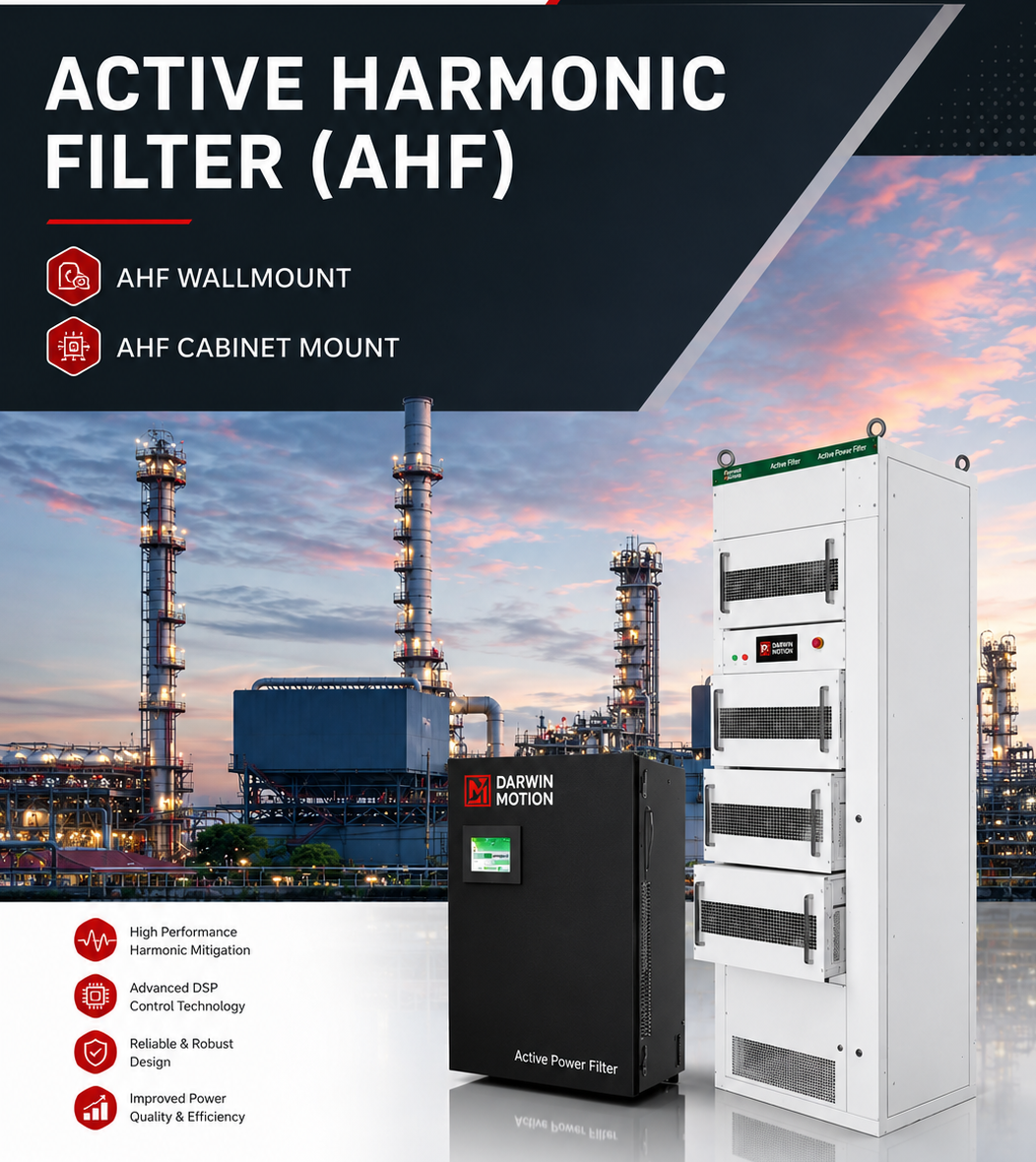
Industrial power systems are becoming increasingly dependent on advanced electrical equipment, automation technologies, variable frequency drives (VFDs), rectifiers, UPS systems, and other non-linear loads. While these technologies improve operational efficiency and productivity, they can also introduce harmonic distortion into electrical networks. Harmonics can negatively affect power quality, increase equipment heating, reduce system efficiency, and lead to unexpected operational interruptions.
One of the most effective solutions for addressing these challenges is installing an Active Harmonic Filter. Designed to detect and compensate for harmonic currents in real time, an Active Harmonic Filter helps maintain cleaner power, improve electrical system performance, and protect critical industrial equipment.
As a trusted Darwin Motion AC Drive manufacturer, Darwin Motion focuses on advanced power quality and industrial automation solutions that help industries achieve reliable, efficient, and stable electrical operations.
An Active Harmonic Filter is an advanced power electronic device designed to reduce harmonic distortion caused by non-linear electrical loads. It continuously monitors the electrical system, identifies unwanted harmonic currents, and injects compensating currents to neutralize them.
Unlike conventional passive harmonic filters, which are generally designed for specific harmonic frequencies, active filters can dynamically respond to changing load conditions and compensate for multiple harmonic orders.
An Active Harmonic Filter operates through an intelligent compensation process:
Installing an Active Harmonic Filter offers several operational and financial advantages for industries that depend on stable and reliable electrical power.
Power quality is essential for maintaining consistent industrial operations. Harmonic distortion can affect voltage and current waveforms, creating disturbances throughout the electrical distribution network.
An Active Harmonic Filter reduces unwanted harmonic currents and helps maintain cleaner electrical waveforms. Improved power quality supports the reliable operation of sensitive equipment, automated machinery, control systems, and industrial processes.
Harmonic currents contribute to additional heating in transformers, cables, motors, and other electrical components. Excessive heating can accelerate insulation deterioration and reduce equipment lifespan.
By minimizing harmonic distortion, an Active Harmonic Filter helps reduce unnecessary electrical losses and thermal stress on electrical infrastructure.
Harmonics can increase current flow and contribute to additional losses in electrical distribution systems. These losses can reduce the overall efficiency of industrial installations.
An Active Harmonic Filter helps reduce harmonic-related losses by compensating for unwanted harmonic currents. This supports more efficient utilization of electrical infrastructure and can contribute to lower operating costs.
Unexpected electrical disturbances can interrupt production, affect sensitive machinery, and cause costly downtime.
Harmonic distortion may contribute to nuisance tripping, control system malfunctions, and overheating of electrical equipment.
Installing an Active Harmonic Filter helps maintain better power quality, reducing harmonic-related electrical disturbances and supporting more stable industrial operations.
Certain Active Harmonic Filter systems offer reactive power compensation in addition to harmonic mitigation.
This additional capability can help improve the overall power factor of an industrial installation, depending on the filter configuration and application requirements.
Note: Harmonic compensation and reactive power compensation are separate functions. The filter must be appropriately configured to provide both.
Variable Frequency Drives are widely used in industrial applications such as pumps, compressors, conveyors, HVAC systems, and manufacturing machinery.
Although VFDs improve motor control and energy efficiency, their power electronic front ends can generate harmonic currents.
An Active Harmonic Filter installed at an appropriate point in the electrical distribution system helps reduce harmonic distortion generated by multiple VFDs and other non-linear loads.
As a Darwin Motion AC Drive manufacturer, Darwin Motion understands the importance of maintaining power quality in industrial automation environments where VFDs and other power electronic devices operate together.
High harmonic currents can increase the electrical loading on transformers, cables, neutral conductors, and switchgear.
An Active Harmonic Filter helps reduce harmonic-related current stress, allowing electrical distribution systems to operate more reliably.
This is particularly beneficial for industries with multiple non-linear loads operating simultaneously, such as:
Industrial electrical loads rarely remain constant throughout the day. Production schedules, machinery operations, and varying motor speeds can continuously change the harmonic profile of an electrical system.
An Active Harmonic Filter provides dynamic compensation by continuously monitoring the network and adjusting its output according to changing load conditions.
This makes it suitable for modern industrial facilities where electrical demand varies significantly during operation.
Maintaining harmonic distortion within acceptable limits is an important part of industrial power quality management.
Standards such as IEEE 519 provide guidelines and recommended limits for harmonic control at the point of common coupling (PCC).
An appropriately selected and configured Active Harmonic Filter can help industrial facilities manage harmonic distortion and work towards meeting applicable power quality requirements.
Actual compliance depends on system design, installation conditions, load characteristics, and measurements at the relevant assessment point.
As industries expand their production capacity, additional motors, drives, automation equipment, and electrical loads are often introduced.
An Active Harmonic Filter can be selected and configured according to the electrical system's requirements. Modular and parallel-connected configurations are available in suitable systems, making it easier to accommodate increasing harmonic compensation demands.
This provides industries with greater flexibility when upgrading or expanding their electrical infrastructure.
Active Harmonic Filters are suitable for a wide range of industrial environments where non-linear loads create harmonic distortion.
Manufacturing facilities use VFDs, welding equipment, robotic systems, and automated production machinery. Active harmonic filtering helps improve power quality and supports reliable production operations.
Textile manufacturing involves numerous motors, drives, spinning machines, and other electrically operated equipment. Harmonic compensation helps maintain stable electrical conditions across production lines.
Large HVAC installations and industrial compressors frequently use variable speed drives. Active harmonic filters help manage the harmonic currents generated by these systems.
Data centres depend on UPS systems, power converters, and other electronic equipment. Harmonic mitigation helps support reliable power distribution for critical infrastructure.
Pumping stations, blowers, and treatment equipment often use multiple VFDs. Active harmonic filters help manage harmonic distortion in these electrically intensive facilities.
Both active and passive harmonic filters are used to reduce harmonic distortion, but they operate differently.
| Parameter | Active Harmonic Filter | Passive Harmonic Filter |
|---|---|---|
| Operating Principle | Active current injection | Passive LC components |
| Harmonic Compensation | Dynamic | Generally tuned to selected frequencies |
| Load Variation | Adapts to changing loads | Less adaptable |
| Multiple Harmonics | Can compensate multiple harmonic orders | Usually designed for specific harmonic orders |
| System Flexibility | High | Application-dependent |
| Reactive Power Compensation | Available in suitable configurations | Depends on design |
The selection between active and passive filtering depends on harmonic levels, load characteristics, installation requirements, and project economics.
Choosing the right Active Harmonic Filter requires proper evaluation of the industrial electrical network.
Professional system assessment and correct installation are essential for achieving the expected performance.
Selecting the right power quality solution is important for improving industrial productivity and maintaining reliable electrical infrastructure.
Darwin Motion AC Drive manufacturer focuses on industrial automation and advanced power quality solutions designed to address modern electrical challenges.
With an emphasis on engineering, application requirements, and industrial performance, Darwin Motion supports businesses looking to improve their electrical systems and optimize their operations.
Explore the Darwin Motion Active Harmonic Filter solution to learn more about harmonic mitigation and power quality improvement for industrial applications.
Harmonic distortion is a significant power quality challenge for modern industrial facilities. If left unmanaged, it can contribute to equipment overheating, increased electrical losses, operational disturbances, and reduced system reliability.
Installing an Active Harmonic Filter is an effective approach to managing harmonic currents and improving industrial power quality. From reducing equipment stress and supporting energy efficiency to improving system performance under varying load conditions, active filtering offers several important benefits.
For industries seeking reliable electrical performance and advanced power quality solutions, Darwin Motion AC Drive manufacturer offers solutions worth exploring.
Explore our Active Harmonic Filter solutions and take a step towards cleaner, more reliable, and efficient electrical systems.


